
Since 28 November 1870
Our Lodge
A lodge with a long memory.
How we began
Norman Lodge was consecrated on Monday 28 November 1870 at the Masonic Hall, Old Elvet, in Durham. The ceremony was performed by the Provincial Grand Master, John Fawcett, and the Reverend George Bulman was installed as our first Master. We are a daughter lodge of the Marquis of Granby Lodge No. 124: the nine members who signed the petition to Grand Lodge all belonged to it, as did most of those who joined us in the early months.
The founders were practical people. At their last meeting before the consecration they agreed that the luncheon should cost four shillings a head. In our first ten years we welcomed sixty-three more members, a third of them joining from other lodges across the Province.
The rest of this page is our history in brief, drawn from the lodge’s own records.
The story so far
-
The hall is built
The Masonic Hall in Old Elvet is built as a purpose-made lodge, to the design of the local architect T. C. Eddy, according to the City of Durham Trust. Its front carries the square and compasses, a six-pointed star and an eye within a triangle.
-
Consecration
Norman Lodge is consecrated at Old Elvet. We begin with nineteen joining members and four candidates, and a luncheon at four shillings a head. The officers of that first year are listed here.
-
The first initiate
William Singlehurst, proposed at the consecration, is initiated at the second regular meeting and made Tyler, the officer who guards the door of the lodge.
-
A loyal address
The lodge writes to Queen Victoria on the recovery of the Prince of Wales from a dangerous illness. The reply from Whitehall records that Her Majesty received the address very graciously.
-
1881 and 1890
Helping new lodges into being
Members sign the petitions for two new lodges: Whitworth Lodge at Spennymoor in 1881, and Universities Lodge, consecrated on 22 February 1890.
-
A banner for the new century
A Provincial visit marks the unfurling of a new banner, the gift of W. Bro. William Gray, Deputy Mayor of Durham and for many years the lodge’s Treasurer.
-
The Past Masters’ panel
The panel commemorating every Past Master of the lodge is unveiled at Old Elvet, and remains one of our most treasured possessions. The roll is here.
-
1914 to 1918
The Great War
Thirty-three members serve in the forces and two give their lives. At home the lodge carries on, gives 25 guineas to the Prince of Wales’s National Relief Fund and, when one of its members is interned in Germany, sends him a football.
-
Jubilee
Our fiftieth year is celebrated with the Provincial Grand Master and his officers. A commemorative jewel is offered to members, priced to leave a profit for the Royal Masonic Institution for Boys.
-
The Sanctuary Knocker
W. Bro. Edwin Picton presents the lodge with a replica of the knocker on the North Door of Durham Cathedral. Its story is below.
-
1939 to 1945
The Second World War
On 3 October 1939 the dining hall at Old Elvet is taken over as a forces canteen, and it is not handed back until 1946. The Past Masters’ Room serves as the dining room in the meantime. Members go to war, and for some who had only just been initiated, progress in the Craft waits for their return.
-
25 November and 2 December 1970
Our centenary
A Centenary Ball is held at Durham Castle. The Centenary Meeting takes place in the Chapter House of Durham Cathedral, where a cheque for 1,000 guineas is presented to the Provincial Grand Master and a new banner, designed and made by one of our own members, is dedicated. The officers and members of that year are listed here.
-
Today
Still at Old Elvet
We meet on the third Wednesday of the month, except July and August, in the hall where we were consecrated. New members are welcome, and there is more about how to join.
-
Looking ahead
In 1970 the members planned a trust fund so that, in our bicentenary year, the lodge can give 2,000 guineas, or its twenty-first-century equivalent, to the Province. We are, it seems, a patient organisation.
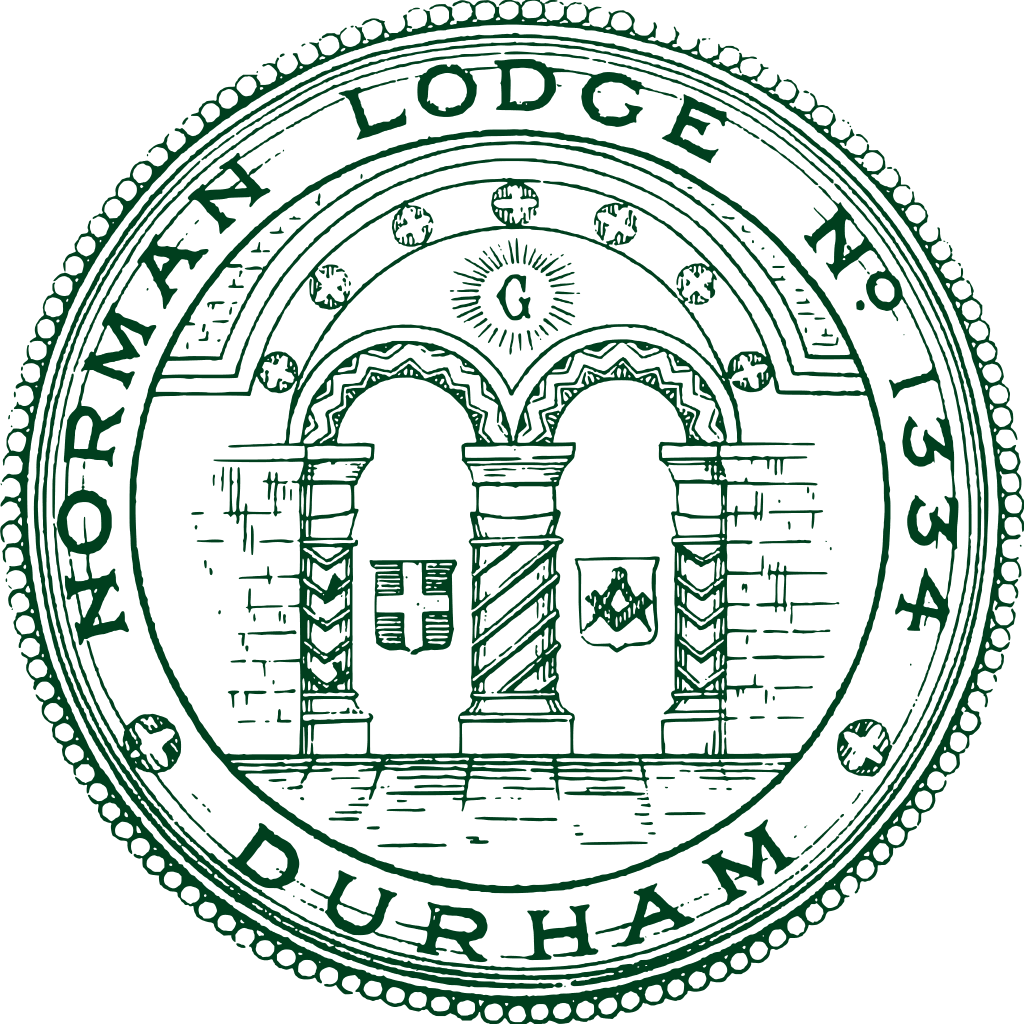
Our seal
The crest
A Norman arcade, drawn like an old engraving.
Inside a beaded ring bearing the lodge’s name, number and city stand two round arches with zigzag mouldings, carried on a spiral pillar between two pillars carved with chevrons. Above them shines a radiant G. Two small shields stand in the openings, one bearing a cross and the other the square and compasses. Roundels with crosses follow the line of the great arch, and the floor is tiled.
It is the stonework Durham is known for, and it is where this website found its look: the round arches, the zigzag bands and the beaded rings all come from the crest.
A door at which anyone may knock
The Sanctuary Knocker
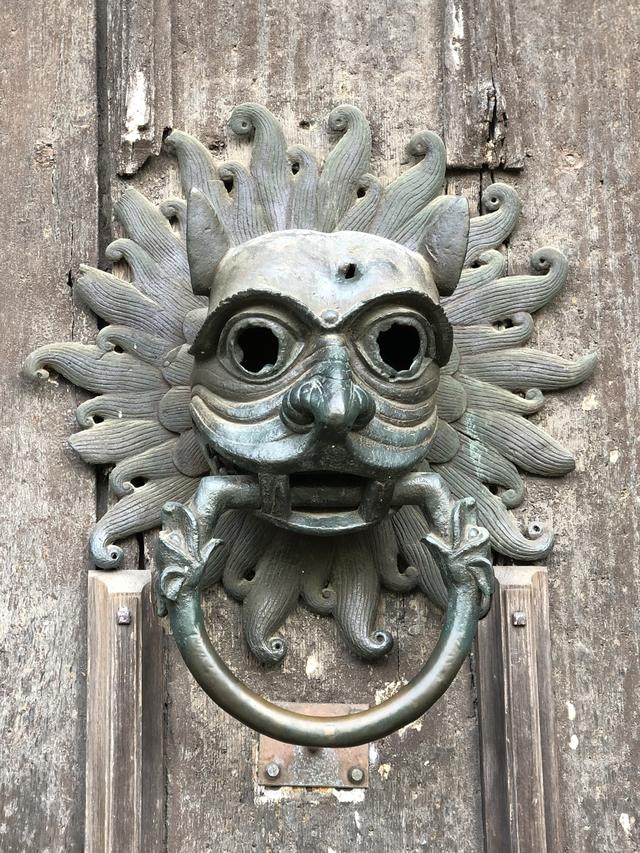
Durham Cathedral, begun in 1093, was for centuries a place of sanctuary. Anyone fleeing the law who reached the North Door could seize the great bronze knocker. Two watchmen in a chamber above the door would answer, and the fugitive was admitted and given protection for up to thirty-seven days, during which he had to choose between trial and exile.
In June 1931 the lodge was given a replica of that knocker. The one on the door today is itself a copy, placed there in 1980, and the original is in the Cathedral’s museum.
We have always liked the idea of a door at which anyone may knock.
Relief, in the old sense
Good works
Charity has been part of the lodge since the year it was founded. A few highlights from the records show how the causes have changed and the habit has not.
- 1888
- Ten guineas to the Royal Masonic Institution for Girls, one of the three great Masonic charities of the day.
- 1897
- A response to an appeal for famine victims in India.
- 1900
- A donation to our brethren in South Africa during the Boer War.
- 1908
- Five guineas, matched by a collection among the members, for the workless poor of the Tyne and Tees towns.
- 1914
- Twenty-five guineas to the Prince of Wales’s National Relief Fund, and the month’s alms to the Mayor of Durham’s Belgian Relief Fund.
- 1924
- Help for the victims of an earthquake in Japan.
- 1928
- Monthly collections for the Durham Castle Restoration Fund.
- 1930s
- Regular gifts to Durham County Hospital.
- 1970
- One thousand guineas for Masonic charities, in our centenary year.
- 1993
- The first Norman Lodge Golf Day, organised by the Master of the year. It ran for at least fourteen years and raised more than £10,000 for charity.
From the 1930s the lodge’s annual gift to the Durham Masonic Charities was rarely less than fifty guineas, and the national Masonic charities for children and the elderly have had our support since our earliest years.
A friend to the city
The lodge and the city have always been on good terms. By our own count twenty-four members have served as Mayor of Durham, and one of them, Mayor in 1928, was given the Freedom of the City in October 1945 for long and faithful service.
Add a chapter
Every name on the Past Masters’ panel began with a conversation.